DISCLAIMER - NIKZAFRI.BLOGSPOT.COM

Today, Knowledge Management today are not limited merely to : (A) 'knowing' or 'reading lots of books/scholarly articles' or (B) data mining, analysis, decision making, preventive actions, or (C) some Human Resources Management issue or (D) some ICT issue. Knowledge Management is about putting your knowledge, skills and competency into practice and most important IT WORKS! For you and your company or your business (Nik Zafri) Offering the best training and consultancy.

The information comprised in this section is not, nor is it held out to be, a solicitation of any person to take any form of investment decision. The content of the nikzafri.blogspot.com does not constitute advice or a recommendation by nikzafri.blogspot.com and should not be relied upon in making (or refraining from making) any decision relating to investments or any other matter. You should consult your own independent financial adviser and obtain professional advice before exercising any investment decisions or choices based on information featured in this nikzafri.blogspot.com can not be held liable or responsible in any way for any opinions, suggestions, recommendations or comments made by any of the contributors to the various columns on nikzafri.blogspot.com nor do opinions of contributors necessarily reflect those of http://www. nikzafri.blogspot.com

In no event shall nikzafri.blogspot.com be liable for any damages whatsoever, including, without limitation, direct, special, indirect, consequential, or incidental damages, or damages for lost profits, loss of revenue, or loss of use, arising out of or related to the nikzafri.blogspot.com or the information contained in it, whether such damages arise in contract, negligence, tort, under statute, in equity, at law or otherwise.


MY EMPLOYERS AND CLIENTELLES


A THOUGHT

It’s wonderful to revisit the past, though not every memory is nostalgic some can drain your spirit to live. I find the present while learning valuable lessons from the past (so they’re not repeated), and focus on the future gives me a sense of closure, ownership, even drives me to move forward, and feels truly empowering.

Perhaps it's time to recite this daily mantra - that "enough is enough" - "no more being a victim, I'm retaking control of myself and my life"

BIODATA - NIK ZAFRI


NIK ZAFRI BIN ABDUL MAJID,
CONSULTANT/TRAINER
Email: nikzafri@yahoo.com, nikzafri@gmail.com
https://nikzafri.wixstudio.com/nikzafriv2

Kelantanese, Alumni of Sultan Ismail College Kelantan (SICA), Business Management/Administration, IT Competency Cert, Certified Written English Professional US. Has participated in many seminars/conferences (local/ international) in the capacity of trainer/lecturer and participant.

Affiliations :- Council/Network Member of Gerson Lehrman Group, Institute of Quality Malaysia, Auditor ISO 9000 IRCAUK, Auditor OHSMS (SIRIM and STS) /EMS ISO 14000 and Construction Quality Assessment System CONQUAS, CIDB (Now BCA) Singapore),

* Possesses almost 30 years of experience/hands-on in the multi-modern management & technical disciplines (systems & methodologies) such as Knowledge Management (Hi-Impact Management/ICT Solutions), Quality (TQM/ISO), Safety Health Environment, Civil & Building (Construction), Manufacturing, Motivation & Team Building, HR, Marketing/Branding, Business Process Reengineering, Economy/Stock Market, Contracts/Project Management, Finance & Banking, etc. He was employed to international bluechips involving in national/international megaprojects such as Balfour Beatty Construction/Knight Piesold & Partners UK, MMI Insurance Group Australia, Hazama Corporation (Hazamagumi) Japan (with Mitsubishi Corporation, JA Jones US, MMCE and Ho-Hup) and Sunway Construction Berhad (The Sunway Group of Companies). Among major projects undertaken : Pergau Hydro Electric Project, KLCC Petronas Twin Towers, LRT Tunnelling, KLIA, Petronas Refineries Melaka, Putrajaya Government Complex, Sistem Lingkaran Lebuhraya Kajang (SILK), Mex Highway, KLIA1, KLIA2 etc. Once serviced SMPD Management Consultants as Associate Consultant cum Lecturer for Diploma in Management, Institute of Supervisory Management UK/SMPD JV. Currently – Associate/Visiting Consultants/Facilitators, Advisors/Technical Experts for leading consulting firms (local and international), certification bodies including project management. To name a few – Noma SWO Consult, Amiosh Resources, Timur West Consultant Sdn. Bhd., TIJ Consultants Group (Malaysia and Singapore), QHSEL Consultancy Sdn. Bhd.

He is also currently holding the Position of Principal Consultant/Executive Director (Special Projects) - Systems and Methods, ESG, QHSE at QHSEL Consultancy Sdn. Bhd.* Ex-Resident Weekly Columnist of Utusan Malaysia (1995-1998) and have produced more than 100 articles related to ISO-9000– Management System and Documentation Models, TQM Strategic Management, Occupational Safety and Health (now OHSAS 18000) and Environmental Management Systems ISO 14000. His write-ups/experience has assisted many students/researchers alike in module developments based on competency or academics and completion of many theses. Once commended by the then Chief Secretary to the Government of Malaysia for his diligence in promoting and training the civil services (government sector) based on “Total Quality Management and Quality Management System ISO-9000 in Malaysian Civil Service – Paradigm Shift Scalar for Assessment System”

Among Nik Zafri’s clients : Adabi Consumer Industries Sdn. Bhd, (MRP II, Accounts/Credit Control) The HQ of Royal Customs and Excise Malaysia (ISO 9000), Veterinary Services Dept. Negeri Sembilan (ISO 9000), The Institution of Engineers Malaysia (Aspects of Project Management – KLCC construction), Corporate HQ of RHB (Peter Drucker's MBO/KRA), NEC Semiconductor - Klang Selangor (Productivity Management), Prime Minister’s Department Malaysia (ISO 9000), State Secretarial Office Negeri Sembilan (ISO 9000), Hidrological Department KL (ISO 9000), Asahi Kluang Johor(System Audit, Management/Supervisory Development), Tunku Mahmood (2) Primary School Kluang Johor (ISO 9000), Consortium PANZANA (HSSE 3rd Party Audit), Lecturer for Information Technology Training Centre (ITTC) – Authorised Training Center (ATC) – University of Technology Malaysia (UTM) Kluang Branch Johor, Kluang General Hospital Johor (Management/Supervision Development, Office Technology/Administration, ISO 9000 & Construction Management), Kahang Timur Secondary School Johor (ISO 9000), Sultan Abdul Jalil Secondary School Kluang Johor (Islamic Motivation and Team Building), Guocera Tiles Industries Kluang Johor (EMS ISO 14000), MNE Construction (M) Sdn. Bhd. Kota Tinggi Johor (ISO 9000 – Construction), UITM Shah Alam Selangor (Knowledge Management/Knowledge Based Economy /TQM), Telesystem Electronics/Digico Cable(ODM/OEM for Astro – ISO 9000), Sungai Long Industries Sdn. Bhd. (Bina Puri Group) - ISO 9000 Construction), Secura Security Printing Sdn. Bhd,(ISO 9000 – Security Printing) ROTOL AMS Bumi Sdn. Bhd & ROTOL Architectural Services Sdn. Bhd. (ROTOL Group) – ISO 9000 –Architecture, Bond M & E (KL) Sdn. Bhd. (ISO 9000 – Construction/M & E), Skyline Telco (M) Sdn. Bhd. (Knowledge Management),Technochase Sdn. Bhd JB (ISO 9000 – Construction), Institut Kefahaman Islam Malaysia (IKIM – ISO 9000 & Internal Audit Refresher), Shinryo/Steamline Consortium (Petronas/OGP Power Co-Generation Plant Melaka – Construction Management and Safety, Health, Environment), Hospital Universiti Kebangsaan Malaysia (Negotiation Skills), Association for Retired Intelligence Operatives of Malaysia (Cyber Security – Arpa/NSFUsenet, Cobit, Till, ISO/IEC ISMS 27000 for Law/Enforcement/Military), T.Yamaichi Corp. (M) Sdn. Bhd. (EMS ISO 14000) LSB Manufacturing Solutions Sdn. Bhd., (Lean Scoreboard (including a full development of System-Software-Application - MSC Malaysia & Six Sigma) PJZ Marine Services Sdn. Bhd., (Safety Management Systems and Internal Audit based on International Marine Organization Standards) UNITAR/UNTEC (Degree in Accountacy – Career Path/Roadmap) Cobrain Holdings Sdn. Bhd.(Managing Construction Safety & Health), Speaker for International Finance & Management Strategy (Closed Conference), Pembinaan Jaya Zira Sdn. Bhd. (ISO 9001:2008-Internal Audit for Construction Industry & Overview of version 2015), Straits Consulting Engineers Sdn. Bhd. (Full Integrated Management System – ISO 9000, OHSAS 18000 (ISO 45000) and EMS ISO 14000 for Civil/Structural/Geotechnical Consulting), Malaysia Management & Science University (MSU – (Managing Business in an Organization), Innoseven Sdn. Bhd. (KVMRT Line 1 MSPR8 – Awareness and Internal Audit (Construction), ISO 9001:2008 and 2015 overview for the Construction Industry), Kemakmuran Sdn. Bhd. (KVMRT Line 1 - Signages/Wayfinding - Project Quality Plan and Construction Method Statement ), Lembaga Tabung Haji - Flood ERP, WNA Consultants - DID/JPS -Flood Risk Assessment and Management Plan - Prelim, Conceptual Design, Interim and Final Report etc., Tunnel Fire Safety - Fire Risk Assessment Report - Design Fire Scenario), Safety, Health and Environmental Management Plans leading construction/property companies/corporations in Malaysia, Timur West Consultant : Business Methodology and System, Information Security Management Systems (ISMS) ISO/IEC 27001:2013 for Majlis Bandaraya Petaling Jaya ISMS/Audit/Risk/ITP Technical Team, MPDT Capital Berhad - ISO 9001: 2015 - Consultancy, Construction, Project Rehabilitation, Desalination (first one in Malaysia to receive certification on trades such as Reverse Osmosis Seawater Desalination and Project Recovery/Rehabilitation), ABAC Centre of Excellence UK (ABMS ISO 37001) Joint Assessment (Technical Expert)

He is also rediscovering long time passions in Artificial Intelligence, ICT and National Security, Urban Intelligence/Smart Cities, Environmental Social and Governance, Solar Energy, Data Centers - BESS, Tiers etc. and how these are being applied.

* Has appeared for 10 consecutive series in “Good Morning Malaysia RTM TV1’ Corporate Talk Segment discussing on ISO 9000/14000 in various industries. For ICT, his inputs garnered from his expertise have successfully led to development of work-process e-enabling systems in the environments of intranet, portal and interactive web design especially for the construction and manufacturing. Some of the end products have won various competitions of innovativeness, quality, continual-improvements and construction industry award at national level. He has also in advisory capacity – involved in development and moderation of websites, portals and e-profiles for mainly corporate and private sectors, public figures etc. He is also one of the recipients for MOSTE Innovation for RFID use in Electronic Toll Collection in Malaysia.

Note :


TO SEE ALL ARTICLES

ON THE"LABEL" SECTION BELOW (RIGHT SIDE COLUMN), YOU CAN CLICK ON ANY TAG - TO READ ALL ARTICLES ACCORDING TO ITS CATEGORY (E.G. LABEL : CONSTRUCTION) OR GO TO THE VERY END OF THIS BLOG AND CLICK "Older Posts"


Sunday, March 09, 2025

THE 21ST CENTURY PROJECT MANAGEMENT - Tips by Nik Zafri (Malaysia vs International)


Note : This article is also based mostly on my 30 years experience in the capacities of a Client, Consultant and Contractor. I am proud to be part of the solution for some of the projects mentioned herein. Almost all examples/case studies are based on real construction projects in Malaysia and International.

Becoming the best construction project management requires a mix of technical knowledge, leadership skills, and on-the-ground experience. Based on professional experiences from seasoned experts in the field, here are the best ways :

1. FUNDAMENTALS

1.1 Strong foundation in construction methods, materials, and project management principles,

1.2 Construction Methode.g. Post-Tensioned Concrete Slabs

Source : EPP Concrete

  • Instead of traditional reinforced concrete slabs, post-tensioning involves steel tendons that are tensioned after the concrete has set.
  • This method reduces material usage, minimizes cracking, and allows for longer spans in buildings, reducing the need for columns.
  • Commonly used in high-rise buildings and parking structures for structural efficiency and cost savings.

Tips : Work together with C & S or M & E Engineer - those who are in charge of developing construction method statement.

1.3 Construction Material 

e.g. Autoclaved Aerated Concrete (AAC) Blocks

Source : Cement Plant Supplier dot com

  • AAC blocks are lightweight, energy-efficient, and have excellent fire resistance.
  • Compared to traditional red clay bricks, they offer better insulation, faster installation, and reduced dead load on structures.

Tips : AAC are mostly used in sustainable building projects to improve thermal performance and reduce environmental impact.

1.4 Project Management Principle 

e.g. Earned Value Management (EVM)

EVM is a project tracking method that combines cost, schedule, and performance to measure project progress. It helps project managers make data-driven decisions to bring the project back on track.

Tips : If a construction project has a budget of $1 million and after 50% of the timeline, only 40% of the work is completed, EVM will highlight that the project is behind schedule and over budget.

1.5 Contracts, procurement, and local regulations to navigate compliance issues

1.5.1 Contract (Malaysia)

e.g. Malaysia: PAM 2006/2018 ( [PAM] Pertubuhan Akitek Malaysia - Malaysian Institute of Architects) Standard Form of Contract

  • Used for private sector building projects in Malaysia,
  • Covers contractor’s obligations, progress payments, variation orders, and dispute resolution.

Tips : If a contractor fails to complete a project on time, Liquidated Ascertained Damages (LAD) clauses in PAM contracts allow the employer to claim compensation for delays.

1.5.2 International

e.g. FIDIC - International Federation of Consulting Engineers Red Book (Conditions of Contract for Construction)


  • Commonly used for large-scale infrastructure projects worldwide,
  • Includes design responsibility, payment terms, variations, and dispute resolution.

Tips: Typically, in an international project, if the employer delays providing site access, the contractor can claim Extension of Time (EOT) and additional costs under FIDIC clauses.

1.6 Procurement (Malaysia)

e.g. CIDB Malaysia (Construction Industry Development Board) Pre-Qualification and Open Tendering


In Malaysia, government projects follow open tendering through the ePerolehan system. (Treasury)

Tips : If a contractor wants to bid for a government hospital project, they must be registered with CIDB (G7 for high-value contracts) and meet technical, financial, and performance criteria.

1.7 International 

e.g. The World Bank Procurement Guidelines

Used for projects funded by international agencies.

Tips: Say for example - Malaysia receives World Bank funding for a flood mitigation project, procurement must follow transparent bidding rules to prevent corruption and ensure fair competition. (Refer to ISO 37001 ABAC)

1.8.1 Local (Malaysian) 

e.g. Uniform Building By-Laws (UBBL) 1984

Governs fire safety, structural integrity, and building design.

Tips: UBBL requires that high-rise buildings have fire escapes and smoke extraction systems. If a developer does not comply, they cannot obtain a Certificate of Completion and Compliance (CCC).

1.8.2 International

e.g. OSHA (Occupational Safety and Health Administration – USA

Ensures workplace safety in construction.

Tips : OSHA requires fall protection measures for workers on scaffolding above 6 feet. Failure to comply can result in heavy penalties and project shutdowns.

Source : Simplified Safety Dot Com

2. KNOW THE TRENDS

2.1 #BIM (Malaysia) Building Information Modelling

Source : Malay Mail

e.g. MRT Line 2 (Malaysia – Klang Valley Mass Rapid Transit)

  • BIM was used for clash detection in M & E works, ensuring no conflicts between underground utilities and building structures, 

  • Reduced rework and delays by identifying design issues before construction began,

  • Enabled better coordination between consultants, contractors, and suppliers in real-time using a 3D digital model.

2.2 #BIM (International) Building Information Modelling

Source : CNN Media

e.g. Beijing #Daxing International Airport ( #China )

  • BIM was used to coordinate the design and construction of the massive airport, which covers 700,000 square meters.

  • Enabled real-time collaboration between architects, engineers, and contractors to detect clashes in complex structures.

  • Reduced construction time by 6 months and ensured high precision in steel and concrete works.

2.3 Project Management Software (Malaysia)

e.g. #Primavera P6 ( #Oracle )

e.g. Project : High-Rise Construction in Kuala Lumpur

Source : ecentral.my

  • Used in projects like TRX ( Tun Razak Exchange ) skyscrapers to track schedule, budget, and resource allocation.
  • Helped project managers monitor critical paths and prevent project delays.

Tips : If concrete pouring is delayed due to rain, Primavera P6 recalculates the schedule to avoid affecting other tasks like steelworks and M&E installations.

2.4 Project Management Software (International)

Source : businesswire.com
e.g. #Procore


e.g. Project Hudson Yards New York Development (USA) 

  • One of the largest private real estate developments in the U.S.
  • Used Procore to manage contracts, RFIs (Requests for Information), submittals, and project documentation across multiple buildings.
Tips : Procore helps project managers track progress in real-time and streamline communication between developers, architects, and subcontractors.

2.5 Sustainable Building Practices (Malaysia)

e.g. Green Building Index ( #GBI ) Malaysia

e.g. Project : Menara Kerjaya Prospek (Platinum-Rated GBI Building in KL) ( Kerjaya Prospek Group Bhd)

  • Used rainwater harvesting, solar panels, and energy-efficient lighting to reduce operational costs.
  • Designed with natural ventilation and low-E glass windows to minimize air-conditioning use.
Tips : By using recycled materials in construction, the project reduced carbon footprint and achieved a GBI Platinum rating - Malaysia’s highest sustainability certification.

2.6 Sustainable Building Practices (International)

e.g. LEED-Certified Skyscrapers

Source : Wikipedia

e.g. The Edge ( #Amsterdam, #Netherlands)
  • Considered the world’s most sustainable office building, achieving a #LEED Platinum rating,
  • Uses solar panels, rainwater harvesting, and an AI-driven smart lighting system that adjusts based on occupancy.
  • Reduced energy consumption by 70% compared to conventional office buildings.

3. HANDS ON EXPERIENCE

3.1 Work on-site early in your career to understand the practical aspects of construction.

3.1.1 Work On-Site Early and Understand Practical Construction Aspects ( #Malaysia )

Source : Wikipedia

e.g. Merdeka 118 Tower (Kuala Lumpur, Malaysia)

Junior engineers and site supervisors working on this 678.9m skyscraper gained hands-on experience in : 
  • Deep foundation works, including bored piling for stability on challenging ground conditions,
  • Structural sequencing, ensuring concrete curing and high-rise steelwork were coordinated to prevent structural stress,
  • Coordination with M&E teams to integrate power and HVAC systems within a tight core structure.

3.1.2 Work On-Site Early and Understand Practical Construction Aspects (International)

e.g. #London Crossrail (United Kingdom)

Young engineers on Europe’s biggest rail project gained experience in:
  • Tunnel boring machine ( #TBM ) operations to dig under London without disturbing existing buildings.
  • Managing waterproofing and drainage issues in complex underground stations.
  • Learning logistics coordination, ensuring materials arrived at constrained city-center sites on time.

4. CHALLENGES, DELAY AND HSE ISSUES (Malaysia)

Source : Wikipedia

e.g. Pan Borneo Highway (Sabah & Sarawak, Malaysia) (Pan Borneo Highway Asset Management Sdn Bhd)

4.1 How Site Supervisors and Engineers Handle them

Challenge : Site supervisors faced delays due to unpredictable weather and remote locations.

Solution - Adopted modular bridge components, allowing faster installation even in rain-prone areas.

HSE Challenge - Work in dense forest areas required strict wildlife impact assessments and controlled blasting for excavation.

4.2 How Site Supervisors and Engineers Handle them (International)

Source : Wikipedia
e.g. Burj Khalifa ( #Dubai, #UAE ) ( Burj Khalifa LLC )

Challenge: Extreme heat (up to 50°C) affected concrete curing and worker health.

Solution: Concrete was poured at night to prevent premature setting and cracking.

HSE Issues: Cooling stations were installed on-site, and work shifts were adjusted to prevent heatstroke.


5. COST CONTROL AND VALUE ENGINEERING 

5.1 (Malaysia)

Source : AECOM

e.g. Second Penang Bridge (Sultan Abdul Halim Muadzam Shah Bridge, Malaysia)

Cost Challenge: The original design required expensive deep foundations due to the seabed condition.

Value Engineering Solution: Used high-durability marine concrete with precast pier segments, reducing construction costs by 20%.

5.2 (International)
Source : Wikipedia

e.g. The Shard (London, #UK) #TheShard

Cost Challenge: The Shard’s high-rise design required heavy steel framing, which was costly.

Value Engineering Solution: Used a top-down construction method, allowing the lower floors to be built while deep foundations were still being excavated—saving months of construction time and labor costs.


6. MANAGING AND MOTIVATING 

6.1 (Malaysia)

6.1.1 Target Group : Contractors, Engineers, Suppliers

e.g. MRT Putrajaya Line (Malaysia)

Challenge: 
  • Diverse teams from different backgrounds (local & international contractors, engineers, suppliers).
  • Language barriers and differing work ethics slowed coordination.
Solution:
  • Regular toolbox meetings to align expectations and provide clear daily targets,
  • Used multilingual communication boards on-site for better clarity.
  • Recognized worker contributions with safety awards and performance incentives, keeping morale high.

6.2 (International)


e.g. Three Gorges Dam (China)

Challenge:
  • Coordinating 30,000 workers, local and foreign engineers, and over 100 suppliers.
  • Extreme weather conditions and long shifts led to worker fatigue.
Solution:
  • Rotational shifts to avoid burnout.
  • Created on-site dormitories, canteens, and recreation zones to improve worker welfare.
  • Clear communication channels through daily briefings and digital updates for all stakeholders.

7. CONFLICT RESOLUTION (Disputes Between Stakeholders)

7.1 (Malaysia) 

e.g. LRT3

Dispute:

Cost overruns led to a dispute between the government, main contractor (MRCB George Kent), and subcontractors over payment structures.

Resolution:
  • Government restructured the contract from PDP (Project Delivery Partner) to a fixed-price contract, reducing project costs by RM15 billion.
  • Contractors had to adjust to a new procurement model but were assured of on-time payments and contract transparency.
7.2 (International) 

e.g. BER - Berlin Brandenburg Airport (Germany)

Dispute:

Project delays and poor design coordination led to legal disputes between the German government, architects, and construction firms.

Resolution:
  • Appointed a third-party independent arbitrator to mediate conflicts,
  • Revamped contractor responsibilities with stricter milestone-based payments,
  • Introduced transparent reporting and digital tracking to prevent further delays.

8. CLEAR INSTRUCTIONS AND REPORTS (to Avoid Miscommunication)

8.1 (Malaysia) 

www.malaysia.travel

e.g. Petronas Twin Towers (Malaysia) #KLCC #PETRONAS 

Issue:

During construction, the two towers were found to be misaligned by 25mm due to early measurement miscommunication.

Solution:

Implemented a strict reporting protocol:
  • All critical measurements had to be double-verified and documented before execution,
  • Clear daily reporting templates were used to track alignment corrections.

8.2 (International)

Source : Getty Images

e.g. #Sydney Opera House, #Australia

Problem : 

Unclear structural drawings caused steel miscalculations, leading to redesign delays.

Solution:

  • Introduced detailed, standardized documentation, ensuring all engineers and contractors received the same clear information.
  • Established a dedicated review team to cross-check reports before approvals.

9.0 RISK MANAGEMENT AND MITIGATION 

9.1 Anticipating Problems and Solution (Malaysia)

Source : Wikipedia

e.g. East Coast Rail Link ( #ECRL)

Risk:

The project passes through challenging terrains, including hilly and soft soil areas, leading to potential landslides and settlement issues.

Mitigation : 
  • Conducted geotechnical risk assessments early, allowing engineers to select soil stabilization techniques (such as deep soil mixing and retaining walls) before major problems occurred,
  • Used LiDAR and drone technology for continuous monitoring of high-risk zones.

9.1 Anticipating Problems and Solution (International)

e.g. #Panama Canal Expansion (Panama)

Risk:

The high water pressure in the new lock system posed a risk of failure due to unforeseen geological conditions.

Mitigation : 
  • Conducted extensive hydraulic modeling simulations before construction to predict potential failures,
  • Adjusted the concrete mix design and reinforced critical areas with additional steel structures to prevent long-term cracking.

9.3 Contingency Plan for Labour Shortages, Material Delays and Design Changes

9.3.1 (Malaysia) 

e.g. Klang Valley Mass Rapid Transit (MRT2 – #Putrajaya Line, #Malaysia)

Challenge:

The project faced labor shortages due to foreign worker permit issues and material supply chain disruptions during the COVID-19 pandemic.

Solution:

9.3.1.1 Labor Contingency Plan
  • Reallocated local workforce from less critical areas to key sections,
  • Implemented night shifts to maximize productivity with available manpower.

9.3.1.2 Material Contingency Plan
  • Secured alternative suppliers in advance to avoid complete reliance on single-source vendors,
  • Used precast concrete elements to reduce on-site dependency on raw materials.
9.3.2 (International) 

Source : Google

e.g. One World Trade Center (New York, USA)

Challenge:

Steel price fluctuations and design modifications after 9/11 security reviews caused cost overruns and delays.

Solution:

9.3.2.1 Material Contingency Plan

Locked in long-term contracts with multiple steel suppliers to hedge against price volatility.

9.3.2.2 Design Contingency Plan
  • Kept modular components flexible for adjustments without affecting the project timeline.
  • Used BIM modeling to simulate changes before physical construction, avoiding costly rework.

10. PROACTIVE VS REACTIVE

10.1 (Malaysia) 

e.g. PNB 118 (Merdeka 118 Tower, Malaysia) Permodalan Nasional Berhad 

Proactive:

Engineers anticipated wind load effects on the 678.9m structure, which could cause excessive sway.

Solution:

Integrated a tuned mass damper (TMD) system early in the design phase to counteract wind forces.

Tips : This prevented structural instability issues that could have been costly to address later.

10.2 (International)

Source : Wikipedia

e.g. Hong Kong-Zhuhai-Macau Bridge (China) #HongKong #Zhuhai #Macau #Bridge

Proactive:

Predicted long-term corrosion issues due to constant exposure to seawater.

Solution:

  • Used anti-corrosion concrete and special steel reinforcements coated with epoxy to extend the bridge’s lifespan.
  • Incorporated self-monitoring sensors in the bridge structure to detect early signs of material degradation.

11. STAY ORGANIZED AND BE PREPARED FOR SUDDEN CHANGES

11.1 Use project management tools like #Primavera P6, Microsoft Project, or #Procore to track timelines and resources (See 2.3 above)

11. 2 Detailed Documentation of Work Progress, Change Orders and Contractual Obligations

11.2.1 (Malaysia)

e.g. MRT Kajang Line (MRT1)

Challenge:

  • Frequent design changes due to site constraints and unforeseen underground utilities.
  • Contractors (WPC) required clear documentation of change orders to track variations in scope and cost.

Solution:

  • Used #CDE (Common Data Environment) software to store all contract documents, work progress reports, and change orders in one digital platform.
  • Maintained a structured approval process where each variation order (VO) was documented, approved by the client, and reflected in the payment certificates.

Tips : This prevented disputes over extra costs and scope creep while keeping the project within budget.

11.2.2 (International)

e.g. Crossrail (Elizabeth Line, UK)

Challenge:

Managing thousands of subcontractors across multiple stations, tunnels, and rail segments required strict documentation of progress and contractual obligations.

Solution:

  • Implemented Aconex (Project Document Control Software) to track work progress in real-time.
  • Every change order was logged with a clear paper trail, ensuring transparency in cost variations.

Tips : The detailed record-keeping helped resolve disputes efficiently, preventing legal claims from delaying the project further.

12. QUALITY CONTROL

- Catching Mistakes Early to Prevent Costly Rework

12.1 (Malaysia)

https://themalaysianreserve.com/

e.g. #Petronas Refinery and Petrochemical Integrated Development ( #RAPID, #Pengerang, #Johor, Malaysia)

Issue:

Early in construction, piping and structural steel misalignment was discovered due to inconsistent fabrication tolerances.

Tips : If left unchecked, it could have led to costly rework and safety hazards.

Solution:
  • Introduced laser scanning technology for quality checks before final installation, ensuring perfect alignment,
  • Established strict quality checkpoints at the prefabrication stage, catching errors before materials reached the site.
Tips : The proactive approach saved millions in rework costs and prevented project delays.

12.2 (International) 

e.g. #Burj Khalifa (Dubai, UAE) #BurjKhalifa Dubai #UnitedArabEmirates

Issue:

During construction, concrete shrinkage was found to be higher than anticipated, which could cause structural misalignment in the upper floors.

Solution:
  • Engineers implemented real-time structural monitoring sensors to track concrete shrinkage and adjust accordingly,
  • Quality control teams tested concrete batches extensively before use, ensuring consistency.
Tips : By catching this issue early, they avoided rework on critical load-bearing components, preventing severe delays

13. CLIENT AND STAKEHOLDER

Balancing Client Expectations with On-the-Ground Realities

13.1 (Malaysia) 

e.g. TRX Exchange 106 (Kuala Lumpur, Malaysia) #TRX #KualaLumpur

Challenge:

The client wanted rapid project completion to meet commercial leasing commitments, but complex foundation work (deep piling and excavation) required more time.

Solution:
  • The project team explained technical constraints clearly to the client, emphasizing the risks of rushing structural works,
  • Proposed a phased construction approach where lower floors were handed over earlier for tenant fit-outs while upper floors were still being completed.
Tips : This ensured both safety and client satisfaction without compromising the structural integrity of the skyscraper.

13.2 (International)

e.g. #Doha Metro ( #Qatar ) #DohaMetro

Challenge:

Pushing an unrealistic 2022 FIFA World Cup deadline, despite unforeseen underground utility conflicts delaying tunneling.

Solution:
  • The project team presented a revised schedule with risk assessments, showing why adjusting deadlines was necessary,
  • Used cut-and-cover tunneling methods in some areas to speed up progress without compromising safety.
Tips : This managed the client's expectations while keeping the project on track.

13.3 Maintaining Good Relationships with Subcontractors and Suppliers 

You may need help in Crisis Situations

13.3.1 (Malaysia) 

e.g. Second Penang Bridge (Malaysia) #SecondPenangBridge

Crisis:

Unexpected delays occurred due to concrete supply shortages and issues with marine piling in deep waters.

Solution:

Because of strong relationships with key suppliers, the project team was able to :
  • secure emergency material allocations from alternative suppliers without price hikes,
  • Worked closely with marine piling specialists, negotiating flexible work hours to complete work faster.
Tips : These supplier and subcontractor relationships prevented further delays and kept costs under control.

13.3.2 International 

Source : Wikipedia

e.g. London #Heathrow Terminal 5 (UK) #HeathrowTerminal5

Crisis:

A critical steelwork supplier went bankrupt mid-project, threatening the terminal’s structural completion.

Solution:

Because the main contractor, BAA , had good relationships with secondary suppliers, they were able to quickly source steel from alternative suppliers in Spain without significant cost increases.

Tips : The supply chain adaptability minimized disruption and kept the project moving.

14. TRANSPARENCY 

14.1 (Malaysia) 

e.g. MRT2 (Putrajaya Line, Malaysia)

Issue:

Ground settlement near Persiaran APEC Station caused cracks in adjacent buildings.

Response:

  • MRT Corp immediately informed the public and stakeholders, explaining the cause and corrective measures. #MRTCorp
  • Implemented real-time monitoring systems and compensated affected property owners.

Tips : This built public trust and prevented legal disputes, ensuring smoother project continuation.

14.2 (International) 

e.g. Sydney Opera House Renovation (Australia)

Issue:

During a major renovation, unexpected structural deterioration was discovered in the foundation, risking long delays.

Response:

Engineers openly communicated the issue with stakeholders and the public, explaining why repairs were necessary.

Tips : The transparency helped secure additional funding and adjusted timelines, ensuring the project could be completed without cutting corners.

15. LESS BUT NOT LEAST - NEVER STOP LEARNING

  • Attend industry seminars, certification courses (like #PMP, #RICS, or #LEED), and network with senior professionals.
  • Learn from past mistakes and successes - analyze what worked and what didn’t on every project.

Tips : Stay adaptable - construction is constantly evolving, and a rigid mindset won’t work.


Friday, February 28, 2025

SHARING ECONOMY VS TRADITIONAL BRICK AND MORTAR IN THE 21ST CENTURY – BY NIK ZAFRI


The 21st century has seen a dramatic shift in how businesses operate, with the rise of the sharing economy challenging traditional brick-and-mortar businesses. The question of which is better depends on various factors, including industry, customer preferences, and economic conditions. 


(I still notice that many Malaysians are reluctant to use the simple Touch ‘n Go eWallet, citing reasons such as avoiding “taxes” (without realizing the benefits of the point system) and using “political excuses” (despite the fact that both high-ranking officials from the ruling government and the opposition also utilize it).


SO, WHICH ONE IS BETTER

Well, empirically speaking for a person who have been in both shoes - it all goes back to the industry and business model. You can't simply shift drastically from brick and mortar to sharing economy just because your competitor are doing it - what you need is Proper Planning.
  • For services and rentals (transportation, accommodation, freelance work)Sharing Economy is winning due to flexibility and lower costs.
  • For products requiring a physical experience (luxury retail, dining, personal care) Brick-and-Mortar still holds value due to customer trust and experience.
  • For hybrid models - personally speaking - I would prefer this model (restaurants using food delivery apps, physical stores with online platforms) → The future may lie in a blended approach, where traditional businesses leverage digital tools.

Ultimately, businesses that adapt and integrate technology into their models - whether they are in the sharing economy or traditional sectors - will thrive in the 21st century.

(Your choice - and don't say "capital" or "money" as an excuse - there are so many resources available, as long as you want it)


Monday, February 24, 2025

RETAIL AND E-COMMERCE SECTORS IN MALAYSIA FROM 2023-2025 AND HOW AI IS BECOMING THE GAME CHANGER – OVERVIEW BY NIK ZAFRI


Between 2023 and 2025, Malaysia's retail and e-commerce sectors have experienced significant growth, driven by technological advancements, evolving consumer behaviors, and supportive government initiatives. 

1.0  Growth Trajectory

1.1 Market Expansion

In 2023 alone, Malaysia's e-commerce market reached approximately $10.2 billion, marking a 12.2% increase from the previous year.

Projections indicate that by 2028, the market will grow at a compound annual growth rate (CAGR) of 8.5%, reaching $15.7 billion.


2.0 Mobile Commerce Surge

The rise in smartphone usage has propelled mobile commerce, with mobile transactions accounting for over 50% of all online transactions. This trend is expected to continue, emphasizing the importance of mobile-optimized platforms for retailers.


3.0 Key Developments

3.1 Government Initiatives

The National eCommerce Strategic Roadmap (NESR) has been pivotal in promoting e-commerce adoption among small and medium-sized enterprises (SMEs). Between 2016 and 2023, approximately 1.51 million SMEs embraced e-commerce, enhancing their market reach and operational efficiency.

3.2 Alternative Payment Methods

In 2023, alternative payment solutions, including digital wallets and bank transfers, accounted for 35.7% of e-commerce transactions. This shift reflects consumers' preference for convenient and secure payment options.


4.0 Impact on the ASEAN Region

Malaysia's e-commerce growth significantly influences the broader ASEAN market. Among them :

4.1 Regional Trade Enhancement

The expansion of Malaysia's e-commerce facilitates increased cross-border trade within ASEAN, promoting regional economic integration and providing consumers with a wider array of products.

4.2 SME Empowerment

E-commerce serves as a crucial export enabler for ASEAN-6 micro, small, and medium-sized enterprises (MSMEs). Notably, 90% of these MSMEs reported that they would not be able to export without e-commerce platforms, underscoring the sector's role in regional economic development.


Conclusion

From 2023 to 2025, Malaysia's retail and e-commerce sectors have undergone substantial growth, driven by technological adoption, supportive policies, and changing consumer preferences. This progression not only bolsters Malaysia's economy but also contributes to the economic dynamism of the ASEAN region.


HOW ARTIFICIAL INTELLIGENCE BECOMES A GAME CHANGER IN RESHAPING MALAYSIA’S RETAIL AND E-COMMERCE SECTORS

1.0 AI and Digital Transformation in Malaysia's Retail and E-Commerce

1.1 Enhanced Customer Experience 

Malaysian e-commerce platforms are leveraging AI to personalize shopping experiences. For instance, Lazada utilizes AI combined with Augmented Reality (AR) to offer personalized skincare solutions, allowing users to analyse their skin and receive tailored product recommendations.

1.2 Operational Efficiency

AI-driven tools are streamlining operations. Shopee's AI chatbot, Sophie, managed 18 million chats in 2023, resolving 80% of cases without human intervention, thereby enhancing customer satisfaction and reducing operational costs.

1.3 Fraud Detection

Payment platforms like iPay88 employ AI to monitor transaction patterns, enabling real-time fraud detection and ensuring secure online transactions.


2.0 Government Initiatives

The Malaysian government is actively fostering AI development. In December 2024, it established the National Artificial Intelligence Office to spearhead AI policy and regulation, aiming to position Malaysia as a regional AI hub.


3.0 Impact on the ASEAN Region

3.1 Economic Growth

AI is projected to boost Southeast Asia's GDP by 10% to 18% by 2030, translating to nearly $1 trillion.

3.2 Digital Integration

ASEAN countries are increasingly adopting digital technologies, enhancing regional connectivity and economic integration. Initiatives like the ASEAN Digital Economy Framework Agreement aim to standardize electronic processes, facilitating seamless digital trade across member states.


Conclusion

In summary, AI and digital transformation are pivotal in advancing Malaysia's retail and e-commerce sectors, contributing to economic growth and fostering deeper integration within the ASEAN region.

Wednesday, February 19, 2025

Looking back at the 10 storey building in Changsha constructed in 28 hours. Lessons that can be learned by others - Overview by Nik Zafri

Photo Source : YouTube Screenshot

Chinese company Broad Group constructed a 10-storey building in just 28 hours and 45 minutes in Changsha, China, using their prefabricated "Living Building" modular construction system. 

Let's look back at this amazing feat of engineering.


Is it safe? Yes, it follows high safety standards

1) Earthquake-resistant up to Magnitude 9.

2) Typhoon-resistant due to the lightweight yet strong stainless steel structure.

3) Uses non-toxic, fire-resistant materials.

4) Modular precision reduces human error and increases durability.

CONCLUSION

The Broad Group's technology proves that high-rise buildings can be constructed at record speed without compromising safety.

Prefabrication and modular building methods are the future of fast, sustainable construction.

This method could revolutionize disaster relief housing, urban expansion, and affordable housing solutions.


Tuesday, February 18, 2025

OSH (Amendment) Act 2022 (OSHA 2022) - The mistakes based on the gap analysis - Nik Zafri


The Occupational Safety and Health (Amendment) Act 2022 (OSHA 2022) in Malaysia introduces several key changes, such as extending OSH responsibilities to all workplaces, stricter penalties, and increased employer accountability. Many organizations face challenges when implementing the new requirements. 

Despite the "excitement" of implementing them, unfortunately I still see some repetition of common mistakes - just like the old OSHA prior to amendment.


Conclusion

Many companies struggle with OSHA 2022 implementation due to a lack of preparation, training, and compliance monitoring. Addressing these mistakes requires early planning, worker engagement, proper documentation, and strong leadership commitment.


Sunday, February 16, 2025

CE 101 - CONCRETE AND BEAM

Required Concrete Volume for a Slab

IN THEORY (Things that sounds simple enough)

Problem Statement : A reinforced concrete slab is to be constructed for a small storage area. The slab has the following dimensions:

Length = 5 meters, Width = 4 meters, Thickness = 0.15 meters

Determine the total volume of concrete required for the slab in cubic meters (m³)

Solution - The volume of concrete can be calculated using the simple formula for volume: V=L×W×T where:

VVV = Volume of concrete (m³), LLL = Length of slab (m), WWW = Width of slab (m), TTT = Thickness of slab (m)

Substituting the given values:

V=5×4×0.15, V=3.0 m³

Thus, the total concrete volume required is 3.0 cubic meters.

IN REALITY (things that many never considered - hence the abovementioned calculations will not really be accurate)

Wastage Factor

1) Some concrete is lost during mixing, transportation, and pouring.
2) (common practice) add 5-10% extra concrete for wastage.

Assuming 10% wastage, the adjusted volume is:
Vfinal​=3.0+(3.0×0.10)=3.3 m³

Risk Management

- Ensure proper formwork and leveling to prevent overuse or underuse of concrete.
- Consider site conditions, such as temperature, to prevent excessive shrinkage cracks.

So theory is not always compatible with reality.

----------------------------

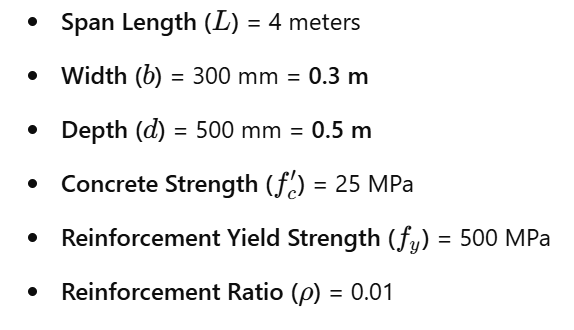
Determining the Maximum Load a Simply Supported Beam Can Carry

A simply supported reinforced concrete beam has the following properties:


Determine the maximum uniformly distributed load (𝑤) the beam can safely support, assuming a singly reinforced section and a safety factor of 1.5.

Determine the Moment Capacity (Mn) of the Beam

The nominal moment capacity of a singly reinforced beam is given by:


Substituting the given values:


First, simplify the fraction inside the parentheses:


Since 11.8 >1, it exceeds the valid range for this formula, meaning we need to check the compression-controlled section. However, for simplicity in this case, let's use a common approximate formula:

Apply the Safety Factor


Find the Maximum Uniform Load (w)

For a simply supported beam with a uniformly distributed load (w) the maximum moment occurs at mid-span and is given by:

The maximum uniformly distributed load the beam can safely carry is 0.56 kN/m.


Risk Management

Deflection Check - Ensure the beam does not deflect excessively under service loads.

Crack Control - Provide sufficient reinforcement to minimize cracks under bending stresses.

Concrete Quality - Ensure proper curing and material selection to achieve the intended strength.


THE CURRENT AND THE FUTURE OF MALAYSIAN DEFENSE - MINI-FACTSHEET BY NIK ZAFRI

Disclaimer : 

This article is based on publicly available civilian research on Malaysian defense, with all sources being non-classified. The future outlook is projected based on AI’s role in global defense technology. No classified information has been disclosed, and the author has exercised utmost caution to ensure compliance with the Official Secrets Act 1972. The author is a civilian, and his views is personal and do not reflect those of the Malaysian defense or armed forces

The image shown above is purely a product of the author's imagination and does not represent any actual Malaysian defense or security buildings. All sources in this article have been cited to the best of the author's ability. However, the information presented may not be entirely accurate, and the author bears no responsibility for any discrepancies or inaccuracies in the data provided.


Over the past three years, Malaysia has undertaken significant efforts to enhance its defense capabilities, focusing on both conventional military strength and cyber defense.

Strength of Malaysia's Defense (2022-2024)

Military Ranking: As of 2025, Malaysia is ranked 42nd out of 145 countries in terms of military strength, with a PowerIndex score of 0.7429 (a lower score indicates greater strength).  (globalpower.com)

Modernization Initiatives

Army - The Malaysian Army has been modernizing its equipment, including the procurement of locally manufactured armored vehicles like the DefTech ACV-300 Adnan and the AV8 Gempita. Plans are also underway to upgrade the PT-91M Pendekar main battle tanks.


The Deftech ACV-300 Adnan 

(Adnan is derived from Lt. Adnan bin Saidi who served as Malayan military officer of the 1st Infantry Brigade under the Malaya Command in British-ruled Malaya - Wikipedia)

Photo Source : https://berita.rtm.gov.my/nasional/senarai-berita-nasional/senarai-artikel/deftech-perkenal-versi-baharu-acv-300-adnan-menerusi-lep 


Photo AV8 Gempita : Wikipedia


Photo PT1-91M Pendekar : Wikipedia


Navy : The Royal Malaysian Navy is enhancing its fleet with projects such as the Maharaja Lela-class frigates and the Littoral Mission Ship (LMS) program. Additionally, there's an ongoing Service Life Extension Program (SLEP) to upgrade existing vessels.


Photo Maharaja Lela-class Frigate  Source : https://www.naval-technology.com


Photo : Keris Class LMS : Wikipedia


Air Force: The Royal Malaysian Air Force is focusing on acquiring new assets, including the KAI T-50 Golden Eagle light combat aircraft and maritime patrol aircraft to bolster aerial and maritime surveillance.


Photo KAI T-50 Golden Eagle : Wikipedia

Cyber Defense Developments

Cyber Security Act 2024: Enacted on August 26, 2024, this legislation establishes a regulatory framework to protect Malaysia's cyber landscape. It mandates that National Critical Information Infrastructure (NCII) entities adhere to specific cybersecurity measures and standards.

National Cyber Security Agency (NACSA): Established in 2017, NACSA serves as the lead agency for cybersecurity matters in Malaysia, coordinating efforts to strengthen the nation's resilience against cyber threats.  

(Source : NACSA)

Ranking of Malaysian Army and Special Forces

Global Standing: In the Lowy Institute's Asia Power Index, Malaysia ranks 16th in military capability among Asian countries (https://power.lowyinstitute.org)

Special Forces: The Malaysian commandoes are renowned special operations force within the Royal Malaysia Police (VAT 69) and the Armed Forces (GGK). While specific global rankings for such elite units are not publicly disclosed, Malaysian special forces is recognized for its counter-terrorism and special operations proficiency.

Efforts in Upgrading Malaysian Defense Capabilities

Enhanced Cybersecurity Measures - With the enactment of the Cyber Security Act 2024, it's imperative to ensure robust implementation across all sectors. Continuous investment in cybersecurity infrastructure and talent development is crucial to counter evolving cyber threats.

Strengthening Defense Partnerships -  Collaborating with allied nations can facilitate technology transfers, joint training exercises, and intelligence sharing. For instance, Malaysia and the United States have conducted joint exercises like Bersama Warrior to enhance interoperability.


Photo : US-Malaysia - Bersama Warrior Emblem. Source : army.mil 


3. Investment in Advanced Technologies: Allocating resources towards emerging technologies such as artificial intelligence, unmanned systems, and advanced surveillance can provide a strategic edge. Partnerships with tech firms, exemplified by Malaysia's collaboration with Google Cloud to offer sovereign cloud services, can further bolster defense capabilities.

4. Comprehensive Training Programs: Regular training and upskilling of military and cybersecurity personnel are essential. Engaging in multinational exercises and simulations can prepare forces for a wide range of scenarios.


THE PROJECTED FUTURE OF MALAYSIAN DEFENSE WITH ARTIFICIAL INTELLIGENCE

For this part, no photos shall be displayed

AI- Enhanced Cyber Defense and Warfare

a. Malaysia's cybersecurity framework is already evolving, with the Cyber Security Act 2024 aiming to protect critical infrastructure.

b. Future developments will likely see AI-powered threat detection, predictive analytics, and automated countermeasures to counter cyber threats.

c. NACSA (National Cyber Security Agency) will likely invest in AI-driven early warning systems to prevent cyber espionage and attacks on government and military networks.

2. AI in Military Decision-Making and Intelligence

AI-driven battlefield analytics will help leaders make faster, data-driven decisions.

Surveillance and reconnaissance operations will use AI-powered drones, sensors, and satellite imaging to enhance situational awareness.

Big Data and AI models will process vast amounts of intelligence for better threat assessment and military planning.

3. Smart Autonomous Weapons and Defense Systems

AI-driven unmanned combat aerial vehicles (UCAVs) and robotic ground forces may be developed for border security and high-risk operations.

Autonomous drones and patrol boats for maritime surveillance, especially in the South China Sea.

AI-driven fire control systems in tanks, fighter jets, and warships to enhance targeting precision.

4. AI-Integrated Special Forces and Counter-Terrorism

Malaysia’s elite units and special forces may leverage AI-powered combat helmets with real-time data feeds, facial recognition, and enemy tracking.

AI-assisted training simulations using virtual reality (VR) and augmented reality (AR) to enhance close-quarters combat (CQC) and urban warfare training.

5. AI in Maritime and Air Defense

AI-powered radar and sonar systems for early detection of threats in Malaysian waters, especially with increasing tensions in the South China Sea.

AI-integrated missile defense systems to enhance threat interception and response speed.

Predictive maintenance systems for fighter jets and naval vessels to reduce downtime and enhance operational readiness.

6. Strengthening AI and Military Tech Collaboration

Malaysia will likely partner with AI leaders like the US, South Korea, China, and Turkey to acquire AI-driven defense technologies.

Joint military AI research centers may be established with local universities and tech firms to develop indigenous AI-powered defense solutions.

Malaysia’s Digital Economy Blueprint (MyDigital) may play a role in incorporating AI across national defense industries.


Saturday, February 15, 2025

SKETSA - DO NOT JUDGE A BOOK BY ITS' COVER


This is a clear example of a superficial assessment. That’s why I’d rather not question auditor or inspector's competency, as they should have identified the inadequacy. I have modified certain details to maintain client confidentiality, and they are aware of this post.


The expert has spoken


Apologies Accepted


Conclusion : I may not be the smartest person around, but when it comes to my expertise - something I'm truly passionate about - I know exactly what I'm doing..