Friday, February 28, 2025

SHARING ECONOMY VS TRADITIONAL BRICK AND MORTAR IN THE 21ST CENTURY – BY NIK ZAFRI


The 21st century has seen a dramatic shift in how businesses operate, with the rise of the sharing economy challenging traditional brick-and-mortar businesses. The question of which is better depends on various factors, including industry, customer preferences, and economic conditions. 


(I still notice that many Malaysians are reluctant to use the simple Touch ‘n Go eWallet, citing reasons such as avoiding “taxes” (without realizing the benefits of the point system) and using “political excuses” (despite the fact that both high-ranking officials from the ruling government and the opposition also utilize it).


SO, WHICH ONE IS BETTER

Well, empirically speaking for a person who have been in both shoes - it all goes back to the industry and business model. You can't simply shift drastically from brick and mortar to sharing economy just because your competitor are doing it - what you need is Proper Planning.
  • For services and rentals (transportation, accommodation, freelance work)Sharing Economy is winning due to flexibility and lower costs.
  • For products requiring a physical experience (luxury retail, dining, personal care) Brick-and-Mortar still holds value due to customer trust and experience.
  • For hybrid models - personally speaking - I would prefer this model (restaurants using food delivery apps, physical stores with online platforms) → The future may lie in a blended approach, where traditional businesses leverage digital tools.

Ultimately, businesses that adapt and integrate technology into their models - whether they are in the sharing economy or traditional sectors - will thrive in the 21st century.

(Your choice - and don't say "capital" or "money" as an excuse - there are so many resources available, as long as you want it)


Monday, February 24, 2025

RETAIL AND E-COMMERCE SECTORS IN MALAYSIA FROM 2023-2025 AND HOW AI IS BECOMING THE GAME CHANGER – OVERVIEW BY NIK ZAFRI


Between 2023 and 2025, Malaysia's retail and e-commerce sectors have experienced significant growth, driven by technological advancements, evolving consumer behaviors, and supportive government initiatives. 

1.0  Growth Trajectory

1.1 Market Expansion

In 2023 alone, Malaysia's e-commerce market reached approximately $10.2 billion, marking a 12.2% increase from the previous year.

Projections indicate that by 2028, the market will grow at a compound annual growth rate (CAGR) of 8.5%, reaching $15.7 billion.


2.0 Mobile Commerce Surge

The rise in smartphone usage has propelled mobile commerce, with mobile transactions accounting for over 50% of all online transactions. This trend is expected to continue, emphasizing the importance of mobile-optimized platforms for retailers.


3.0 Key Developments

3.1 Government Initiatives

The National eCommerce Strategic Roadmap (NESR) has been pivotal in promoting e-commerce adoption among small and medium-sized enterprises (SMEs). Between 2016 and 2023, approximately 1.51 million SMEs embraced e-commerce, enhancing their market reach and operational efficiency.

3.2 Alternative Payment Methods

In 2023, alternative payment solutions, including digital wallets and bank transfers, accounted for 35.7% of e-commerce transactions. This shift reflects consumers' preference for convenient and secure payment options.


4.0 Impact on the ASEAN Region

Malaysia's e-commerce growth significantly influences the broader ASEAN market. Among them :

4.1 Regional Trade Enhancement

The expansion of Malaysia's e-commerce facilitates increased cross-border trade within ASEAN, promoting regional economic integration and providing consumers with a wider array of products.

4.2 SME Empowerment

E-commerce serves as a crucial export enabler for ASEAN-6 micro, small, and medium-sized enterprises (MSMEs). Notably, 90% of these MSMEs reported that they would not be able to export without e-commerce platforms, underscoring the sector's role in regional economic development.


Conclusion

From 2023 to 2025, Malaysia's retail and e-commerce sectors have undergone substantial growth, driven by technological adoption, supportive policies, and changing consumer preferences. This progression not only bolsters Malaysia's economy but also contributes to the economic dynamism of the ASEAN region.


HOW ARTIFICIAL INTELLIGENCE BECOMES A GAME CHANGER IN RESHAPING MALAYSIA’S RETAIL AND E-COMMERCE SECTORS

1.0 AI and Digital Transformation in Malaysia's Retail and E-Commerce

1.1 Enhanced Customer Experience 

Malaysian e-commerce platforms are leveraging AI to personalize shopping experiences. For instance, Lazada utilizes AI combined with Augmented Reality (AR) to offer personalized skincare solutions, allowing users to analyse their skin and receive tailored product recommendations.

1.2 Operational Efficiency

AI-driven tools are streamlining operations. Shopee's AI chatbot, Sophie, managed 18 million chats in 2023, resolving 80% of cases without human intervention, thereby enhancing customer satisfaction and reducing operational costs.

1.3 Fraud Detection

Payment platforms like iPay88 employ AI to monitor transaction patterns, enabling real-time fraud detection and ensuring secure online transactions.


2.0 Government Initiatives

The Malaysian government is actively fostering AI development. In December 2024, it established the National Artificial Intelligence Office to spearhead AI policy and regulation, aiming to position Malaysia as a regional AI hub.


3.0 Impact on the ASEAN Region

3.1 Economic Growth

AI is projected to boost Southeast Asia's GDP by 10% to 18% by 2030, translating to nearly $1 trillion.

3.2 Digital Integration

ASEAN countries are increasingly adopting digital technologies, enhancing regional connectivity and economic integration. Initiatives like the ASEAN Digital Economy Framework Agreement aim to standardize electronic processes, facilitating seamless digital trade across member states.


Conclusion

In summary, AI and digital transformation are pivotal in advancing Malaysia's retail and e-commerce sectors, contributing to economic growth and fostering deeper integration within the ASEAN region.

Wednesday, February 19, 2025

Looking back at the 10 storey building in Changsha constructed in 28 hours. Lessons that can be learned by others - Overview by Nik Zafri

Photo Source : YouTube Screenshot

Chinese company Broad Group constructed a 10-storey building in just 28 hours and 45 minutes in Changsha, China, using their prefabricated "Living Building" modular construction system. 

Let's look back at this amazing feat of engineering.


Is it safe? Yes, it follows high safety standards

1) Earthquake-resistant up to Magnitude 9.

2) Typhoon-resistant due to the lightweight yet strong stainless steel structure.

3) Uses non-toxic, fire-resistant materials.

4) Modular precision reduces human error and increases durability.

CONCLUSION

The Broad Group's technology proves that high-rise buildings can be constructed at record speed without compromising safety.

Prefabrication and modular building methods are the future of fast, sustainable construction.

This method could revolutionize disaster relief housing, urban expansion, and affordable housing solutions.


Tuesday, February 18, 2025

OSH (Amendment) Act 2022 (OSHA 2022) - The mistakes based on the gap analysis - Nik Zafri


The Occupational Safety and Health (Amendment) Act 2022 (OSHA 2022) in Malaysia introduces several key changes, such as extending OSH responsibilities to all workplaces, stricter penalties, and increased employer accountability. Many organizations face challenges when implementing the new requirements. 

Despite the "excitement" of implementing them, unfortunately I still see some repetition of common mistakes - just like the old OSHA prior to amendment.


Conclusion

Many companies struggle with OSHA 2022 implementation due to a lack of preparation, training, and compliance monitoring. Addressing these mistakes requires early planning, worker engagement, proper documentation, and strong leadership commitment.


Sunday, February 16, 2025

CE 101 - CONCRETE AND BEAM

Required Concrete Volume for a Slab

IN THEORY (Things that sounds simple enough)

Problem Statement : A reinforced concrete slab is to be constructed for a small storage area. The slab has the following dimensions:

Length = 5 meters, Width = 4 meters, Thickness = 0.15 meters

Determine the total volume of concrete required for the slab in cubic meters (m³)

Solution - The volume of concrete can be calculated using the simple formula for volume: V=L×W×T where:

VVV = Volume of concrete (m³), LLL = Length of slab (m), WWW = Width of slab (m), TTT = Thickness of slab (m)

Substituting the given values:

V=5×4×0.15, V=3.0 m³

Thus, the total concrete volume required is 3.0 cubic meters.

IN REALITY (things that many never considered - hence the abovementioned calculations will not really be accurate)

Wastage Factor

1) Some concrete is lost during mixing, transportation, and pouring.
2) (common practice) add 5-10% extra concrete for wastage.

Assuming 10% wastage, the adjusted volume is:
Vfinal​=3.0+(3.0×0.10)=3.3 m³

Risk Management

- Ensure proper formwork and leveling to prevent overuse or underuse of concrete.
- Consider site conditions, such as temperature, to prevent excessive shrinkage cracks.

So theory is not always compatible with reality.

----------------------------

Determining the Maximum Load a Simply Supported Beam Can Carry

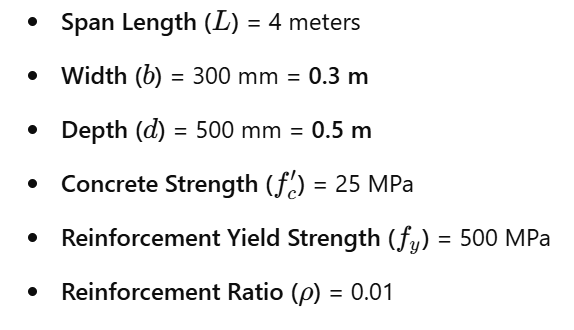
A simply supported reinforced concrete beam has the following properties:


Determine the maximum uniformly distributed load (𝑤) the beam can safely support, assuming a singly reinforced section and a safety factor of 1.5.

Determine the Moment Capacity (Mn) of the Beam

The nominal moment capacity of a singly reinforced beam is given by:


Substituting the given values:


First, simplify the fraction inside the parentheses:


Since 11.8 >1, it exceeds the valid range for this formula, meaning we need to check the compression-controlled section. However, for simplicity in this case, let's use a common approximate formula:

Apply the Safety Factor


Find the Maximum Uniform Load (w)

For a simply supported beam with a uniformly distributed load (w) the maximum moment occurs at mid-span and is given by:

The maximum uniformly distributed load the beam can safely carry is 0.56 kN/m.


Risk Management

Deflection Check - Ensure the beam does not deflect excessively under service loads.

Crack Control - Provide sufficient reinforcement to minimize cracks under bending stresses.

Concrete Quality - Ensure proper curing and material selection to achieve the intended strength.


THE CURRENT AND THE FUTURE OF MALAYSIAN DEFENSE - MINI-FACTSHEET BY NIK ZAFRI

Disclaimer : 

This article is based on publicly available civilian research on Malaysian defense, with all sources being non-classified. The future outlook is projected based on AI’s role in global defense technology. No classified information has been disclosed, and the author has exercised utmost caution to ensure compliance with the Official Secrets Act 1972. The author is a civilian, and his views is personal and do not reflect those of the Malaysian defense or armed forces

The image shown above is purely a product of the author's imagination and does not represent any actual Malaysian defense or security buildings. All sources in this article have been cited to the best of the author's ability. However, the information presented may not be entirely accurate, and the author bears no responsibility for any discrepancies or inaccuracies in the data provided.


Over the past three years, Malaysia has undertaken significant efforts to enhance its defense capabilities, focusing on both conventional military strength and cyber defense.

Strength of Malaysia's Defense (2022-2024)

Military Ranking: As of 2025, Malaysia is ranked 42nd out of 145 countries in terms of military strength, with a PowerIndex score of 0.7429 (a lower score indicates greater strength).  (globalpower.com)

Modernization Initiatives

Army - The Malaysian Army has been modernizing its equipment, including the procurement of locally manufactured armored vehicles like the DefTech ACV-300 Adnan and the AV8 Gempita. Plans are also underway to upgrade the PT-91M Pendekar main battle tanks.


The Deftech ACV-300 Adnan 

(Adnan is derived from Lt. Adnan bin Saidi who served as Malayan military officer of the 1st Infantry Brigade under the Malaya Command in British-ruled Malaya - Wikipedia)

Photo Source : https://berita.rtm.gov.my/nasional/senarai-berita-nasional/senarai-artikel/deftech-perkenal-versi-baharu-acv-300-adnan-menerusi-lep 


Photo AV8 Gempita : Wikipedia


Photo PT1-91M Pendekar : Wikipedia


Navy : The Royal Malaysian Navy is enhancing its fleet with projects such as the Maharaja Lela-class frigates and the Littoral Mission Ship (LMS) program. Additionally, there's an ongoing Service Life Extension Program (SLEP) to upgrade existing vessels.


Photo Maharaja Lela-class Frigate  Source : https://www.naval-technology.com


Photo : Keris Class LMS : Wikipedia


Air Force: The Royal Malaysian Air Force is focusing on acquiring new assets, including the KAI T-50 Golden Eagle light combat aircraft and maritime patrol aircraft to bolster aerial and maritime surveillance.


Photo KAI T-50 Golden Eagle : Wikipedia

Cyber Defense Developments

Cyber Security Act 2024: Enacted on August 26, 2024, this legislation establishes a regulatory framework to protect Malaysia's cyber landscape. It mandates that National Critical Information Infrastructure (NCII) entities adhere to specific cybersecurity measures and standards.

National Cyber Security Agency (NACSA): Established in 2017, NACSA serves as the lead agency for cybersecurity matters in Malaysia, coordinating efforts to strengthen the nation's resilience against cyber threats.  

(Source : NACSA)

Ranking of Malaysian Army and Special Forces

Global Standing: In the Lowy Institute's Asia Power Index, Malaysia ranks 16th in military capability among Asian countries (https://power.lowyinstitute.org)

Special Forces: The Malaysian commandoes are renowned special operations force within the Royal Malaysia Police (VAT 69) and the Armed Forces (GGK). While specific global rankings for such elite units are not publicly disclosed, Malaysian special forces is recognized for its counter-terrorism and special operations proficiency.

Efforts in Upgrading Malaysian Defense Capabilities

Enhanced Cybersecurity Measures - With the enactment of the Cyber Security Act 2024, it's imperative to ensure robust implementation across all sectors. Continuous investment in cybersecurity infrastructure and talent development is crucial to counter evolving cyber threats.

Strengthening Defense Partnerships -  Collaborating with allied nations can facilitate technology transfers, joint training exercises, and intelligence sharing. For instance, Malaysia and the United States have conducted joint exercises like Bersama Warrior to enhance interoperability.


Photo : US-Malaysia - Bersama Warrior Emblem. Source : army.mil 


3. Investment in Advanced Technologies: Allocating resources towards emerging technologies such as artificial intelligence, unmanned systems, and advanced surveillance can provide a strategic edge. Partnerships with tech firms, exemplified by Malaysia's collaboration with Google Cloud to offer sovereign cloud services, can further bolster defense capabilities.

4. Comprehensive Training Programs: Regular training and upskilling of military and cybersecurity personnel are essential. Engaging in multinational exercises and simulations can prepare forces for a wide range of scenarios.


THE PROJECTED FUTURE OF MALAYSIAN DEFENSE WITH ARTIFICIAL INTELLIGENCE

For this part, no photos shall be displayed

AI- Enhanced Cyber Defense and Warfare

a. Malaysia's cybersecurity framework is already evolving, with the Cyber Security Act 2024 aiming to protect critical infrastructure.

b. Future developments will likely see AI-powered threat detection, predictive analytics, and automated countermeasures to counter cyber threats.

c. NACSA (National Cyber Security Agency) will likely invest in AI-driven early warning systems to prevent cyber espionage and attacks on government and military networks.

2. AI in Military Decision-Making and Intelligence

AI-driven battlefield analytics will help leaders make faster, data-driven decisions.

Surveillance and reconnaissance operations will use AI-powered drones, sensors, and satellite imaging to enhance situational awareness.

Big Data and AI models will process vast amounts of intelligence for better threat assessment and military planning.

3. Smart Autonomous Weapons and Defense Systems

AI-driven unmanned combat aerial vehicles (UCAVs) and robotic ground forces may be developed for border security and high-risk operations.

Autonomous drones and patrol boats for maritime surveillance, especially in the South China Sea.

AI-driven fire control systems in tanks, fighter jets, and warships to enhance targeting precision.

4. AI-Integrated Special Forces and Counter-Terrorism

Malaysia’s elite units and special forces may leverage AI-powered combat helmets with real-time data feeds, facial recognition, and enemy tracking.

AI-assisted training simulations using virtual reality (VR) and augmented reality (AR) to enhance close-quarters combat (CQC) and urban warfare training.

5. AI in Maritime and Air Defense

AI-powered radar and sonar systems for early detection of threats in Malaysian waters, especially with increasing tensions in the South China Sea.

AI-integrated missile defense systems to enhance threat interception and response speed.

Predictive maintenance systems for fighter jets and naval vessels to reduce downtime and enhance operational readiness.

6. Strengthening AI and Military Tech Collaboration

Malaysia will likely partner with AI leaders like the US, South Korea, China, and Turkey to acquire AI-driven defense technologies.

Joint military AI research centers may be established with local universities and tech firms to develop indigenous AI-powered defense solutions.

Malaysia’s Digital Economy Blueprint (MyDigital) may play a role in incorporating AI across national defense industries.


Saturday, February 15, 2025

SKETSA - DO NOT JUDGE A BOOK BY ITS' COVER


This is a clear example of a superficial assessment. That’s why I’d rather not question auditor or inspector's competency, as they should have identified the inadequacy. I have modified certain details to maintain client confidentiality, and they are aware of this post.


The expert has spoken


Apologies Accepted


Conclusion : I may not be the smartest person around, but when it comes to my expertise - something I'm truly passionate about - I know exactly what I'm doing..


Thursday, February 13, 2025

Monday, February 03, 2025

KISAH KEBERANIAN PAHLAWAN YANG TIDAK DIKENALI SEJARAH KISAH ALI BIN SARIWEE


Serangan Jepun terhadap Pearl Harbour pada tahun 1941 telah menyebabkan peperangan besar yang turut melibatkan rantau Asia dan Pasifik.

Seorang anak (tidak dapat ditulis namanya) dari sebuah bandar di Barat Laut England, telah mencari sejarah kisah perjuangan ayahnya Ali bin Sarawee (anak kelahiran Johor, Malaysia)


MV Tulagi adalah sebuah kapal perdagangan yang dibina pada tahun 1939 syarikat perkapalan Burn Philp Shipping Line yang membawa kargo dari kepulauan Pasifik ke Pelabuhan Australia.
Kapten kapal (ketika satu tragedi berlaku) ialah Leonard Walter, dengan kru terdiri dari 15 pegawai Australia, 26 kru dari India, 7 orang Melayu dan 5 orang anggota Penembak Simpanan Tentera laut Australia - jumlah keseluruhan ialah 54 orang.
Hayat Tulagi berakhir pada 28 Mac, 1944 semasa pelayaran dari dari Sydney ke Colombo memuatkan 1800 tan gandum dan 380 beg surat. Pada jam 11:50 hampir tengah malam, di Lautan Hindi (300km dari Kepulauan Chagos) ditembak oleh sebuah kapalselam Jepun (fakta awal dikatakan ditembak oleh U-Boat German (U-532)
Kesemua pelaut di bawah dek telah mati serta merta dan sebelum Tulagi tenggelam, ramai antara kru kapal berjaya menyelamatkan diri menggunakan 4 rakit kayu yang diikat bersama.
Rakit 1
J.R. Ward (Ketua Jurutera) D.G. Jacobs, "Purser" Kapal, R.T. Charles (Pegawai Kedua) Ali Bin Sariwee (Quartermaster berbangsa Melayu) Quartermaster) 2 orang lagi Quartermasters berbangsa Melayu iaitu Amos dan Kalipan berasal dari Indonesia dan Basu Mian Abdul Bhooya ("greaser" berbangsa India)
Namun dari 4 buah rakit duanya berpecah sehingga tinggal 2 rakit sahaja (Rakit 1 dan 2 yang juga akhirnya berpecah)
Kesemua kru yang terselamat hanya bergantung kepada bekalan biskut, tablet susu dan coklat yang dicatu untuk bulan pertama pertama di mana pada 24 April, bekalan itu dicatu lagi sehingga kehabisan bekalan 2 hari kemudian.
Akhirnya pada 19 Mei, kedua-dua rakit 1 dan 2 itu telah terpisah.
Ketika itulah Ali dan rakan-rakannya telah mencari jalan bagaimana untuk menangkap ikan dan burung untuk dimakan, antara lain :
1) menukar gunting menjadi lembing menggunakan pancang kapal
2) berbaring dengan mata terbuka di mana burung akan datang cuba mematuk mata dan dengan pantasnya ditangkap,
3) Menadah air hujan untuk diminum
Kesemua ikan, burung dan lain-lain terpaksa dimakan mentah-mentah - cukup bekalan untuk 19 hari.
Ketujuh-tujuh anak kapal akhirnya terdampar di sebuah pulau yang bernama Pulau Bijoutier yang sekelilingnya dipenuhi dengan ikan jerung, di Kepulauan Seychelles
Mereka telah diselamatkan pada 26 Mei, 1944 oleh seorang pengurus tanaman Lois Gendron dari pulau berdekatan bernama Alphonse
Keseluruhannya - Rakit 1 telah belayar sejauh 1598 batu nautika (2959km) dalam tempoh hampir 2 bulan.
Pegawai-pegawai Australia memuji kehebatan quartermasters Melayu dan terhutang nyawa kepada mereka.


Ali bin Sariwee kemudiannya diberikan satu testimoni di atas jasabaiknya dan dicadangkan untuk menerima penghargaan - antara isi kandungannya :
"Kami ingin menyatakan bahawa; dalam pendapat kami; tidak mungkin ada yang hidup jika tidak disebabkan oleh kemahiran mereka, semangat mereka yang kuat dan sikap tidak mementingkan diri sendiri"
"Orang-orang Melayu ini selalu peka terhadap peluang mendapatkan (bekalan) makanan dan ianya mungkin disebabkan mereka telah biasa hidup susah dari orang-orang Eropah"
"Ternyata kami terpaksa bergantung kepada orang-orang Melayu ini kerana kekuatan mereka. Kami mencadangkan agar bekalan (makanan) yang mereka perolehi dilebihkan bahagiannya kepada mereka (kerana susah payah mereka mendapatkan makanan) namun mereka telah menolak cadangan ini dan menegaskan ianya mesti dibahagikan samarata"
Hasil dari testimoni ini, Ali bin Sariwee kemungkinan menjadi orang Melayu yang pertama yang dianugerahi :
Pingat Kesatriaan "Most Excellent Order of the British Empire (OBE)" oleh HM King George VI pada tahun 1947. (HM King George VI juga pernah memegang jawatan Maharaja India yang terakhir dari Bangsa British)


Namun kehidupan peribadinya agak tragis - mungkin disebabkan sindrom PSTD hasil pengalaman pahit peperangan, Ali bin Sariwee dikatakan 3 kali berkahwin tetapi telah bercerai.
1) Perkahwinan pertama ialah pada tahun 1947 (tidak diketahui lokasi dan tidak diketahui samada terdapat anak dari perkahwinan ini),
2) Perkahwinan kedua adalah di Australia - mendapat seorang anak perempuan pada awal tahun 50an dan
3) Perkahwinan di England pada awal tahun 60an (mendapat seorang anak lelaki)
Tidak diketahui ke mana Ali bin Sariwee telah menghilang selepas bercerai dengan isterinya yang ketiga.
Anak lelakinya di England - masih hidup, telah berkahwin dan mendapat seorang anak perempuan.